Small gardens have a way of making every piece of furniture earn its place. A bench is no exception. It has to fit a space that may be barely wider than a path, look right against a fence or a house wall, and survive a British winter without loosening at the joints. Chosen well, it will be the best-used square metre in the garden. Chosen badly, it becomes an obstacle you squeeze past every time you go to the shed.
Measure the space, and the route to it
Before you look at a single bench, look at the gap it has to fill. Mark the footprint on the patio with two plant pots or a length of string, then walk around it. You need roughly 60–75cm of clear ground in front of the seat for your legs and for anyone passing behind you. If the bench sits on the route to the bin store or the back gate, aim for closer to a metre.
Then measure the journey the bench will take to get there. A flat-pack bench arrives as a box and will usually go through a side gate, but a fully assembled 150cm two-seater will not bend around a corner, and it will not fit through a 70cm gap. Check your gate, your back door and any narrow passage before you order. If you plan to move the bench to mow beneath it, weight matters as much as width.
Sizes that suit a compact plot
Garden benches are usually sold as two-seaters or three-seaters. A two-seater is typically around 120–130cm wide and seats two adults comfortably; a three-seater runs from about 150cm upwards. In a small garden, a comfortable two-seater almost always works better than a three-seater squeezed against a fence. You rarely seat three people at once, but you will notice the extra 40cm every day.
Depth matters too. Most benches are 55–65cm front to back, with armrests adding a few centimetres. Seat height is usually somewhere between 42cm and 45cm from the ground, which suits most adults; if anyone using it has stiff knees or a bad back, sit on a friend's bench first and see how easy it is to stand up from.
Small-space formats worth knowing
- Backless benches — often only 35–40cm deep, so they tuck under a window or along a narrow path, and can double as a low table or plant shelf.
- Folding benches — fold flat for storage in a shed or behind a door, useful if you need the space back in winter.
- Corner and L-shaped benches — built into an awkward corner, they use space that nothing else fits and can conceal storage underneath.
- Benches with slim arms — a few centimetres of saving on each side can be the difference between a usable path and a shuffle.
- Bench-and-table sets — a small bistro pair gives you somewhere to put a mug without a separate table.
Choosing the right wood
Hardwood is not automatically the answer: balsa is a hardwood, and Western red cedar is a softwood that outlasts many cheap hardwoods. The practical question is whether the timber is naturally durable or properly pressure-treated, and whether it has been raised off the ground so air can circulate.
- Teak — naturally oily and very durable. Left untreated it weathers to a soft silver-grey; oiled, it keeps its honey colour. It is the traditional choice and you pay accordingly.
- Iroko and robinia — comparable durability, often better value, and robinia is grown in Europe, which some buyers prefer.
- Oak — heavy, strong and long-lived, but it needs oiling to hold its colour and its tannins can stain pale paving.
- Cedar — light enough to move single-handed and naturally rot-resistant, though softer underfoot than oak or teak.
- Acacia and eucalyptus — common in mid-range ranges and perfectly serviceable if you oil them each spring.
- Treated softwood — the cheapest option and fine for a painted bench, but expect a shorter life and an annual coat of preservative or paint.
Whatever you choose, look for timber from a certified well-managed source if that matters to you, and check the fixings. Stainless steel or galvanised bolts will outlast plain steel, which rusts and stains the wood around it.
Styles that make a small garden feel bigger
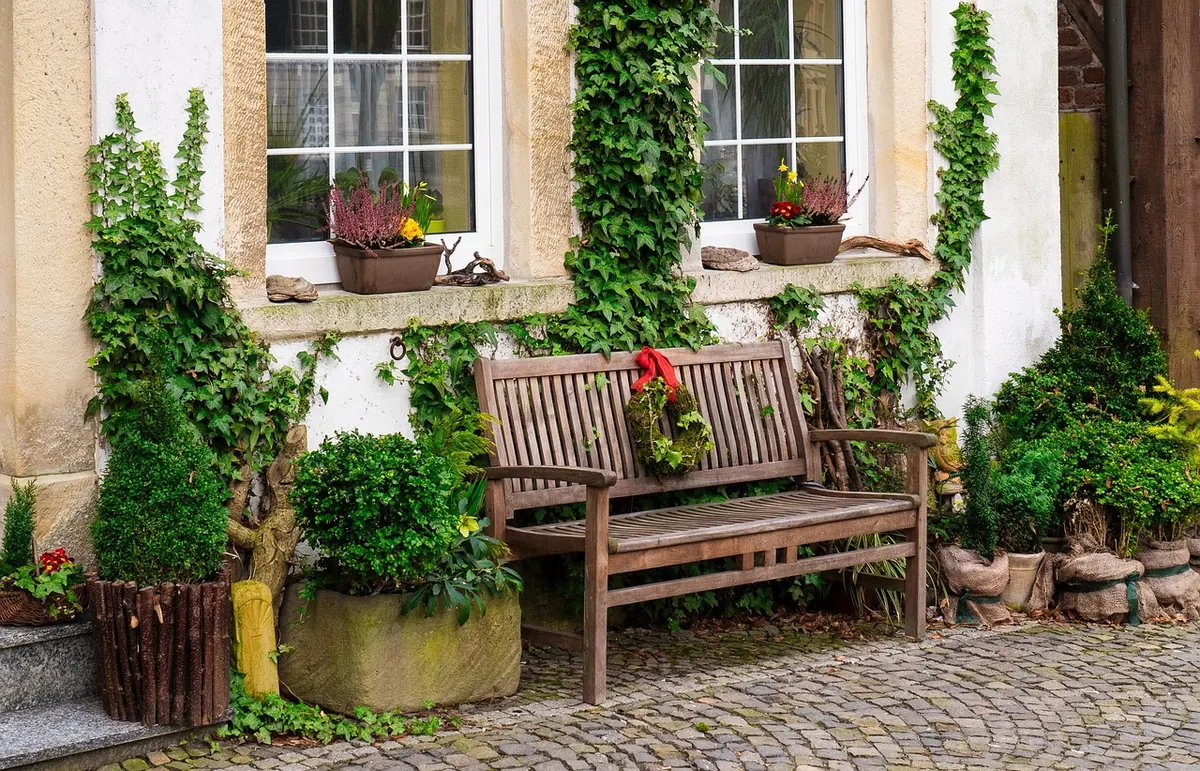
Slatted backs and open arms let light and air through, so a bench placed in front of a window or a border does less to close the space in. A solid high back in a small garden can feel like a wall. Low-backed and backless designs sit below the eyeline when you are standing at the kitchen sink, which keeps the view open.
Colour is worth a thought. A pale, weathered finish blends into planting and makes a tight corner feel calmer; a painted bench in a strong colour — deep green, slate blue, a warm clay red — reads as a feature rather than clutter. Cast-iron ends with wooden slats take up a small footprint, last for decades and suit period terraces, though they are heavy and awkward to move alone.
Position, base and airflow
Put the bench where you actually want to sit at six in the evening, not where it looks tidiest at midday. A bench against a wall or a tall fence is more usable than one in the open, because it blocks the wind and holds the warmth.
Stand it on something level and solid. On grass or bare soil, the legs will sink, stay permanently damp and rot from the bottom up; a couple of paving slabs under the feet solves this. Leave a small gap — a few centimetres — between the back of the bench and the wall or fence so air can move behind it, and avoid any spot where water pools after rain.
Looking after it
Most wooden benches need very little beyond an annual going-over. Scrub with mild soapy water and a stiff brush, let it dry, sand any rough patches lightly and apply a suitable wood oil if you want to keep the colour. Check the bolts each spring and tighten them; loose joints let water in. Cushions should go indoors when not in use, and if you cover the bench in winter, use a breathable cover rather than plastic sheeting, which traps condensation against the wood.
A short checklist before you order
- Width and depth of the space, measured with a tape, not estimated.
- Clearance in front of the bench, and whether people need to walk past it.
- Gate, doorway and passage widths for delivery and assembly.
- Wood type and whether it is naturally durable or pressure-treated.
- Weight — can you move it alone, and will you need to?
- Fixing material: stainless or galvanised rather than plain steel.
- How it will be maintained, and whether you will actually do it.
A bench is one of the few garden purchases you will use sitting down, so it pays to get it right first time. Measure twice, buy a timber that suits your climate and your willingness to oil it, and choose a size that leaves the garden working as a garden rather than a storage yard for furniture.